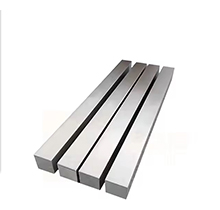
When comparing titanium rods with steel rods, engineers and buyers typically focus on three main considerations: relative strength, potential weight reduction, and whether titanium's corrosion resistance and longer service life justify its higher cost. Common titanium alloys such as Ti-6Al-4V (Grade 5) generally achieve tensile strengths in the range of about 900–1000 MPa, which is comparable to many high-performance alloy steels used in demanding applications. However, titanium has a much lower density, around 4.4 g/cm³ versus approximately 7.8 g/cm³ for steel. As a result, a titanium rod with the same dimensions can be roughly 40–45% lighter while maintaining similar strength performance.
Strength-to-Weight Ratio: Titanium's Key Advantage
The strength‑to‑weight ratio is where titanium rods clearly stand out. Grade 5 titanium (Ti‑6Al‑4V) typically has:
By comparison, many structural and alloy steels used for rods and bars have tensile strengths in a similar range but are significantly denser, around 7.8 g/cm³. That means:
A titanium rod can deliver similar tensile performance to many alloy steels but weigh roughly 40% less.
For weight‑critical systems, you can maintain strength while cutting mass, which directly improves fuel efficiency in aircraft, reduces inertia in moving components, and enhances mobility in medical implants.
For example, a titanium bar with tensile strength around 900 MPa can offer performance close to certain alloy steel bars, but its lower density reduces overall structural weight, especially when many rods or bars are used across a design.
Absolute Strength: When Steel Can Be Stronger
It is important to distinguish strength‑to‑weight ratio from absolute strength:
Some advanced alloy steels and quenched‑and‑tempered steels can exceed 100 MPa tensile strength and reach very high yield strengths.
In purely static load cases where weight is not a concern and the design space is constrained, steel rods can still achieve higher absolute strength or stiffness in a given volume.
Titanium's elastic modulus is also lower than steel's (about 114 GPa for Ti‑6Al‑4V vs about 200 GPa for typical steels), so titanium rods will deflect more under the same load. This is not necessarily a problem, but it means designers must consider stiffness requirements, not just ultimate strength.
Corrosion Resistance: Titanium Outperforms Steel
Another key difference between a titanium rod and a steel rod is corrosion behavior.
Steel rods, including stainless steel, can corrode in aggressive environments such as seawater, chloride‑rich atmospheres, and certain chemical media if the wrong grade or surface condition is used.
Titanium naturally forms a stable, strongly adherent oxide film on its surface, which protects it from many forms of rust and chemical attack.
This oxide layer makes titanium rods particularly well suited for:
Offshore structures and marine engineering exposed to seawater.
Desalination plants and chemical processing equipment with harsh fluids.
Medical implants, where corrosion resistance and biocompatibility are crucial for long‑term performance.
Over the service life of an installation, titanium's corrosion resistance can significantly reduce maintenance, inspection, and replacement costs compared with steel rods in similar environments.
Fatigue Strength and Long-Term Durability
In many applications, rods are subjected to cyclic loads, vibration and temperature changes, not just a single static load. Titanium alloys like Ti‑6Al‑4V exhibit very good fatigue strength and maintain stable mechanical properties over a wide temperature range up to about 400 °C, making them reliable in dynamic and thermal cycling environments.
Steel rods can also deliver good fatigue performance, especially when using high‑quality alloy steels and proper surface treatments, but corrosion damage, pitting or micro‑cracks can accelerate fatigue failure over time. In aggressive environments, titanium's corrosion resistance helps preserve surface integrity, which in turn supports better long‑term fatigue behavior.
Thermal Properties and High-Temperature Behavior
Thermal behavior is another dimension in the titanium rod vs steel rod comparison:
Titanium alloys such as Ti‑6Al‑4V retain good strength up to about 400 °C, making them suitable for many aerospace and industrial applications where temperatures are moderately elevated.
Titanium's lower thermal conductivity compared with steel can reduce heat transfer along a rod, which can be useful in certain designs but must be accounted for in heat management strategies.
Some high‑temperature steel alloys can outperform titanium in extreme heat environments, such as furnace components or certain power‑generation parts, where sustained exposure above titanium's recommended service temperature is expected. For these cases, temperature‑specific data must be checked for both materials.
Machinability, Fabrication and Availability
From a manufacturing perspective, steel rods are generally easier and cheaper to fabricate:
Steel is widely available, straightforward to machine, and compatible with standard cutting tools and processes.
The global supply chain for steel bars and rods is mature, with many standard sizes, grades and certifications readily in stock.
Titanium rods, in contrast, require more specialized handling:
Titanium's lower thermal conductivity and tendency to gall or work‑harden means machining must be done with optimized speeds, feeds, tools and cooling.
Forging and heat treatment of titanium alloy rods also require more controlled conditions, which adds cost and lead time.
These manufacturing realities contribute to titanium rods being significantly more expensive per kilogram than steel rods.
Cost and Total Cost of Ownership
On a per‑kg or per‑meter basis, titanium rods are much more expensive than steel rods due to:
Higher raw material costs.
More complex machining and heat treatment.
More stringent quality control in many aerospace and medical applications.
However, in a total cost of ownership view, titanium can become competitive or even cheaper in certain environments:
Longer service life due to superior corrosion resistance.
Fewer component replacements and less downtime.
Potential system‑wide weight reductions that improve fuel efficiency or performance.
For large‑scale, cost‑sensitive construction and infrastructure projects where weight is less critical, steel rods still offer the best value for money in most cases.
Titanium Rod vs Steel Rod Key Properties
| Property | Titanium Rod (e.g. Ti‑6Al‑4V) | Steel Rod (typical alloy/structural steel) |
|---|
| Density | ~4.4 g/cm³ (about 40–45% lighter than steel) | ~7.8 g/cm³, almost twice as heavy as titanium |
| Tensile strength | ~900–100 MPa for common titanium alloys | Wide range, many structural steels in similar range |
| Strength‑to‑weight ratio | Very high, key advantage in weight‑critical designs | Lower than titanium due to higher density |
| Elastic modulus (stiffness) | ~110–120 GPa, more flexible under load | ~200 GPa, stiffer and less deflection |
| Corrosion resistance | Excellent; stable oxide layer, seawater and chemical resistant | From poor (carbon steel) to good (stainless), but generally inferior in seawater |
| Fatigue and durability | Very good fatigue strength, surface protected from corrosion | Good, but corrosion and pitting can reduce fatigue life |
| Biocompatibility | Excellent; widely used for implants and medical rods | Generally not biocompatible without coatings |
| Temperature capability | Good up to ~400 °C for common alloys | Some steels can operate at higher temperatures |
| Machinability | More difficult; requires special tools and parameters | Easier to machine and weld with standard processes |
| Typical cost level | High material and processing cost | Lower cost, especially for large volumes |
| Best‑fit applications | Aerospace, medical implants, marine, chemical, high‑performance sports | Construction, heavy industry, machinery, cost‑sensitive projects |
Where Titanium Rods Excel
Thanks to their high strength‑to‑weight ratio, corrosion resistance and biocompatibility, titanium rods are widely used in:
Medical implants: orthopedic pins, bone screws, dental rods and spinal fixation systems, where both mechanical strength and compatibility with human tissue are crucial.
Marine engineering: offshore structures, risers, and equipment exposed to seawater, where corrosion can quickly degrade steel.
High‑performance sports equipment: bicycle frames, racing car parts, motorcycle components and outdoor gear, where lower weight improves performance and user experience.
In each of these environments, a titanium rod can outperform a conventional steel rod by offering comparable strength with less weight and far better resistance to corrosive damage.
When Steel Rods Still Lead
Despite titanium's impressive properties, steel rods remain dominant in many applications because of:
Steel rods are often preferred for:
In these cases, choosing steel allows designers to meet strength and safety requirements at a much lower cost, without paying for performance advantages they do not need.
Practical Selection: Titanium Rod vs Steel Rod
To decide whether a titanium rod is “strong enough” or “stronger” than a steel rod in a particular project, engineers should focus on:
In weight‑critical, corrosive or high‑performance environments, a titanium rod—especially a Ti‑6Al‑4V titanium bar—will often deliver better overall value despite higher initial cost. In heavy‑duty but cost‑sensitive environments where corrosion is manageable and weight is secondary, a steel rod is usually the more practical option.
FAQs about How Strong Is a Titanium Rod Compared to Steel?
1. Is a titanium rod stronger than a steel rod?
A titanium rod is not always absolutely stronger than a steel rod, but common titanium alloys such as Ti‑6Al‑4V can reach tensile strengths around 900–100 MPa, similar to many high‑strength steels. The key advantage is that titanium achieves this strength at a much lower weight.
2. How much lighter is a titanium rod than a steel rod?
Titanium's density is about 4.4 g/cm³, while steel is about 7.8 g/cm³, so a titanium rod of the same size can be roughly 40–45% lighter than a steel rod. This is why titanium is popular where weight reduction is vital.
3. Does titanium have a better strength-to-weight ratio than steel?
Yes. Because titanium combines high tensile strength with much lower density, its strength‑to‑weight ratio is superior to most steel grades. That means you get similar or better performance with significantly less mass.
4. Is steel ever stronger than titanium?
Some advanced alloy steels and heat‑treated steels can exceed the tensile strength of common titanium alloys in absolute terms. If weight is not a concern and only maximum strength in a given volume matters, steel can be the stronger choice.
5. Which is more corrosion resistant, titanium or steel?
Titanium is generally far more corrosion resistant than carbon and alloy steels and even outperforms many stainless steels in aggressive environments. Its stable oxide film makes it ideal for seawater, chemical and medical applications.
6. Why are titanium rods more expensive than steel rods?
Titanium rods cost more because titanium is a more expensive raw material and is harder to machine, forge and heat treat. Specialized processing and tight quality control further add to the price compared with conventional steel rods.
7. Are titanium rods suitable for medical implants?
Yes. Titanium alloys such as Ti‑6Al‑4V and their ELI (extra‑low interstitial) variants are widely used for orthopedic and dental implants because they combine high strength, corrosion resistance and excellent biocompatibility.
8. Can I replace a steel rod with a titanium rod one-to-one?
It is sometimes possible, but designers should verify that the titanium rod meets or exceeds the required strength, stiffness and safety factors, and that galvanic corrosion will not be an issue with surrounding materials in a conductive environment. Engineering calculations and relevant standards should always be consulted.
9. In which industries do titanium rods outperform steel rods the most?
Titanium rods tend to outperform steel rods in aerospace, marine engineering, medical implants, chemical processing and high‑performance sports equipment, where the combination of high strength, low weight and superior corrosion resistance is critical.
 English
  日本語
日本語  한국어
한국어  Deutsch
  русский
  العربية